By combining the rapid mixing capability of microflow synthesis with inline analytical techniques that monitor chemical species directly within the flow channel, it becomes possible to obtain information that is extremely difficult, if not impossible, to acquire using conventional flask-based methods. For example, spectral data of reactive intermediates can be collected as early as 0.1 seconds after two solutions are mixed. Such measurements provide a unique opportunity to observe transient chemical species and reaction pathways that have previously remained inaccessible.
Through these advanced analytical approaches, we can explore previously unseen aspects of organic chemistry and gain a deeper understanding of reaction mechanisms. In addition to developing efficient synthetic methodologies, an important objective of our research is to uncover fundamental insights into organic reactions by leveraging the unique capabilities of microflow synthesis and inline analysis.
Preparation and use of a highly reactive electrophile for t-butoxycarbonylation in a microflow reactor
t-Butoxycarbonylation is a widely used transformation in organic synthesis. However, when the nucleophile exhibits low reactivity, the reaction efficiency often decreases significantly. Although this issue can be addressed by employing highly reactive electrophiles, such reagents are generally unstable and prone to decomposition through processes such as decarboxylation.
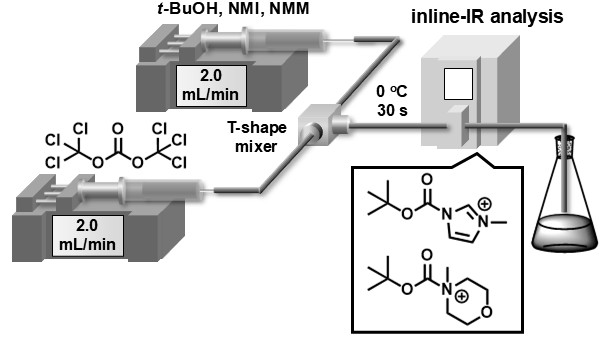
To overcome this challenge, we developed a method in which highly reactive yet unstable electrophilic reagents for t-butoxycarbonylation are generated within a microflow reactor and immediately consumed in the desired reaction before the decomposition can occur. This strategy exploits the precise reaction control and short residence times characteristic of microflow systems, enabling the effective use of reactive species that are difficult to handle under conventional batch conditions.
Furthermore, as illustrated in the figure below, this study demonstrated the detection and characterization of the unstable electrophilic intermediate by inline IR spectroscopy. The ability to monitor such transient species in real time provides valuable mechanistic insight and highlights the power of combining microflow technology with advanced analytical techniques for the study and application of highly reactive intermediates.
Org. Process Res. Dev. 28, (5), 1971-1978 (2024).
One-flow three-component coupling reaction
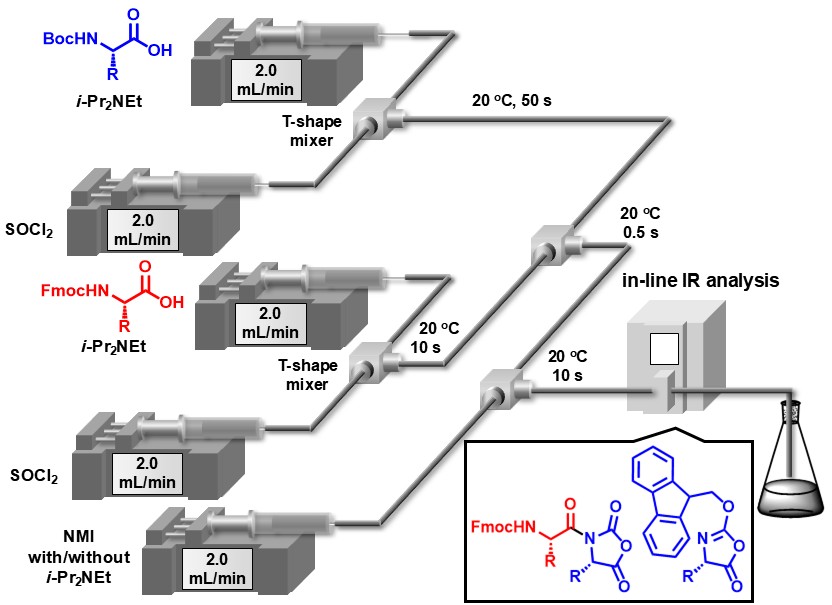
We previously reported the synthesis of cyclic RGD peptides through the combination of a microflow three-component coupling strategy and a microflow peptide cyclization process. In that study, we also demonstrated the detection of reaction intermediates and byproducts that were expected to be generated during the one-flow three-component coupling reaction by means of inline IR spectroscopy. The real-time monitoring of these transient species provided valuable experimental evidence to corroborate the proposed reaction mechanism. Furthermore, the mechanistic insights obtained through inline analysis enabled us to identify pathways leading to undesired byproducts and to develop reaction conditions that effectively suppress their formation.
ChemistryEurope 4, (6), e70326, (2026).
Development of an automated solution-phase peptide flow synthesizer and in-line NIR analysis technique
Compared with conventional flask-based synthesis, microflow synthesis generally involves fewer manual operations and offers superior controllability, making it well suited for automation. Leveraging these advantages, we collaborated with an industrial partner to develop the world’s first automated liquid-phase peptide flow synthesizer.
In the publication described below, we reported not only this pioneering automated synthesis platform but also the first demonstration of real-time monitoring of peptide chain elongation using in-line near-infrared (NIR) spectroscopy. The integration of in-line NIR analysis into the automated flow system enabled continuous, noninvasive observation of the peptide synthesis process, providing immediate information on reaction progress without the need for off-line sampling or analysis.
React. Chem. Eng. 6, (4) 863-870, (2023).